
Product Description
3,5-Dinitrosalicylic Acid (DNS or DNSA, CAS No. 609-99-4) is an aromatic organic acid widely used for the spectrophotometric determination of reducing sugars. It forms a derivative through a redox reaction with reducing sugars, making it a valuable analytical reagent in biochemical and laboratory applications.
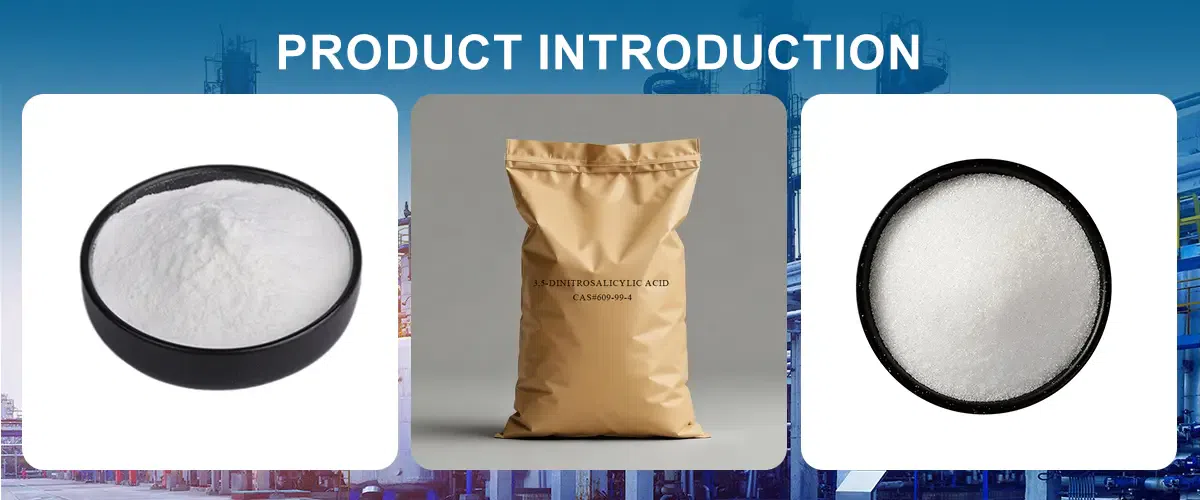
DNSA appears as a yellow, flaky crystalline solid with a melting point of 173–174°C and an estimated boiling point of 369.91°C. It is soluble in alcohols, benzene, and ethers, while only slightly soluble in water. Owing to its reliable analytical performance, it is extensively used for sugar content determination and enzyme activity analysis.
Properties
| Melting point | 168-172 °C (lit.) |
| Boiling point | 369.91°C (rough estimate) |
| density | 1.7914 (rough estimate) |
| refractive index | 1.5300 (estimate) |
| storage temp. | room temp |
| solubility | H2O: soluble50mg/mL |
| form | Powder |
| pka | 1.57±0.10(Predicted) |
| color | Yellow |
| PH Range | 1.3-1.8 (10g/L @ 20°C) |
| Water Solubility | soluble |
| BRN | 2220661 |
| Stability: | Stable. Incompatible with strong oxidizing agents, strong bases, strong acids. |
| LogP | 0.12 at 23℃ and pH2.6-2.8 |
| CAS DataBase Reference | 609-99-4(CAS DataBase Reference) |
| NIST Chemistry Reference | 3,5-Dinitrosalicylic acid(609-99-4) |
| EPA Substance Registry System | Benzoic acid, 2-hydroxy-3,5-dinitro- (609-99-4) |
| Hazard Codes | Xn,Xi |
| Risk Statements | 22-37/38-36/37/38 |
| Safety Statements | 22-24/25-36-26 |
| RIDADR | 2811 |
| WGK Germany | 3 |
| RTECS | VO2965000 |
| Hazard Note | Irritant |
| TSCA | Yes |
| HazardClass | 6.1(b) |
| PackingGroup | III |
| HS Code | 29182990 |
Product Application
3,5-Dinitrosalicylic Acid is primarily used as a pharmaceutical intermediate and as an analytical reagent for glucose determination.
It is widely applied in reducing sugar analysis. Based on the characteristic color reaction of dinitrated salicylic acid derivatives, the DNS method has become a classical standard method for the determination of various reducing sugars, including glucose and maltose.
In addition, it is commonly used in enzyme activity assays to quantitatively measure the amount of reducing sugars released during enzymatic reactions, such as those catalyzed by glycoside hydrolases and amylases, thereby enabling the evaluation of the activity of related enzymes.
Factory Tour

Package And Shipping


