
You have seen titanium dioxide today. Guaranteed. The white paint on your wall. The coating on your fridge. The plastic chair on your balcony. Even the tablet coating on your morning vitamins.
But here is the strange part. This powder, one of the safest-looking chemicals on earth, got kicked out of European food. Fully banned there since 2022. Meanwhile, paint shops and plastic plants across the world keep buying it by the ton.
Confused? Most buyers are. So let's untangle it. What the EU actually banned. What it didn't. And what the rutile titanium dioxide market looks like right now, in September 2026, if you're sourcing for coatings or plastics.
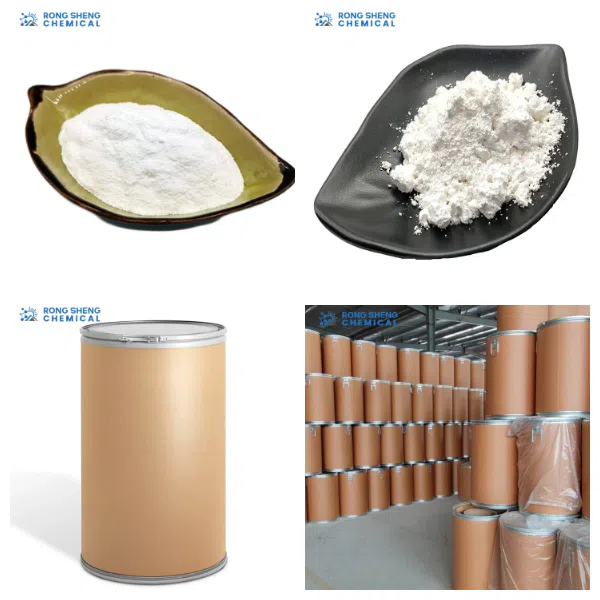
What Is Titanium Dioxide, Exactly?
Chemistry first. Keep it short.
Titanium dioxide is titanium plus oxygen. TiO₂. That's the formula. The CAS number is 13463-67-7, and you'll see that exact string on every safety data sheet: titanium dioxide CAS#13463-67-7. Its formal chemical name is titanium(IV) oxide, though almost nobody in trade calls it that.
It doesn't exist as a pure metal oxide in the ground. Nature gives you ore instead — ilmenite, mostly, or rutile. Refiners pull the titanium out and turn it into titanium dioxide, a brilliant white pigment. And I mean brilliant. Nothing humans make reflects light better. That's not marketing talk. It's physics. The refractive index of rutile TiO₂ sits around 2.7. Diamond? 2.4. So white paint with good pigment covers more surface with less material. That's why roughly 6 million tonnes of the stuff get used every year.
Two crystal forms matter in trade. Rutile and anatase. Rutile packs tighter, hides color better, shrugs off UV. It's the titanium dioxide grade you want outdoors. Anatase is softer, cheaper, whiter in tone, and lives indoors — paper, laminates, some inks. Then there's a process split: sulfate route versus chloride route. Chloride-process grades run cleaner and finer, and they price higher.
One more thing worth knowing. Titanium dioxide carries a food additive code, E171, and an INS number, 171. Doesn't matter for your paint plant. Matters a lot for the EU story below.
Why Did the EU Ban It in Food?
Here's the timeline, stripped of lawyer-speak.
For decades, E171 was everywhere. Candy shells. Cake icing. Chewing gum. Regulators on every continent waved titanium dioxide through.
Then in May 2021, the European Food Safety Authority looked hard at the data and blinked. Their conclusion: a genotoxic effect couldn't be ruled out. In plain words — they couldn't prove the pigment never damages DNA. Not "it damages DNA." Just "we can't rule it out."
That was enough. Regulation (EU) 2022/63 deleted E171 from the EU's approved food additives. From 7 February 2022, no new food with it could hit EU shelves. From 7 August 2022, existing stock had to go too. France had already pulled it back in January 2020.
Now the part that trips people up. In November 2022, the EU General Court threw out the separate CLP classification that labeled powdered titanium dioxide a suspected inhalation carcinogen. And on 1 August 2025, the Court of Justice confirmed it. The harmonized "Carc. 2" tag is gone. Companies no longer have to print that hazard statement on industrial grades.
So the current picture looks contradictory, and honestly, it is:
①Food in the EU: banned. E171 can't go in. Only medicines still get an exemption.
②Industrial use in the EU: legal. Paints, plastics, inks, ceramics — all fine.
③The US, China, Japan, Australia: food use still allowed. The FDA caps it at 1% of food weight.
The gap keeps causing real trade pain. Border rejections happen monthly. The EU's RASFF alert system has logged 13 notifications on Chinese food products containing undeclared TiO₂ since 2023, including confectionery rejected at the Irish border as recently as February 2026. If you ship anything white and edible to Europe, check the label twice.
So Is the Industrial Grade Safe?
For factories, the answer is basically yes — with dust discipline.
The food ban hinged on eating titanium dioxide, particle by particle, over a lifetime. Nobody eats paint. The industrial concern was always about breathing fine powder, and the courts have since walked back the automatic cancer label on that. But walking back a label isn't the same as saying dust is harmless. It isn't.
Regulators in France still push strict workplace air limits for nano forms. And under REACH, the titanium dioxide industry consortium owes ECHA fresh inhalation-toxicology data on 13 forms of the pigment — nano and micro — by the end of 2026. That file lands soon, and it could shape future handling rules.
Practical floor rules for handling titanium dioxide powder haven't changed though:
①Keep powder airborne. Local exhaust ventilation at transfer points and mixers.
②Gloves, goggles, and a proper dust mask for bagging work. A P2 or N95 does the job.
③Don't sweep dry spills with a broom. Vacuum them or wet-wipe.
Handle it like flour, not like plutonium. That's the honest summary.
Rutile Titanium Dioxide for Paint and Coating: Where the Volume Goes
Paint and coatings eat about 60% of global titanium dioxide supply. Maybe more. Walk through any building and you're surrounded by titanium dioxide.
Why? Two reasons. Opacity and durability. Rutile titanium dioxide for paint and coating work scatters light so well that a thin film hides whatever's underneath. And it doesn't chalk or yellow the way cheaper extenders do, especially outdoors. Exterior emulsion paints, automotive topcoats, powder coatings, marine primers — all lean on titanium dioxide.
The trade-off is price. TiO₂ is usually the most expensive raw material in a white paint formula. So formulators stretch it with calcium carbonate and clays where they can. When pigment prices jump, that stretching intensifies. Remember that when we get to the market numbers below.
Plastics come next, around 18% of demand. Then paper, then inks. Same logic everywhere: white means light-scattering power, and that power comes from one specific powder — titanium dioxide.
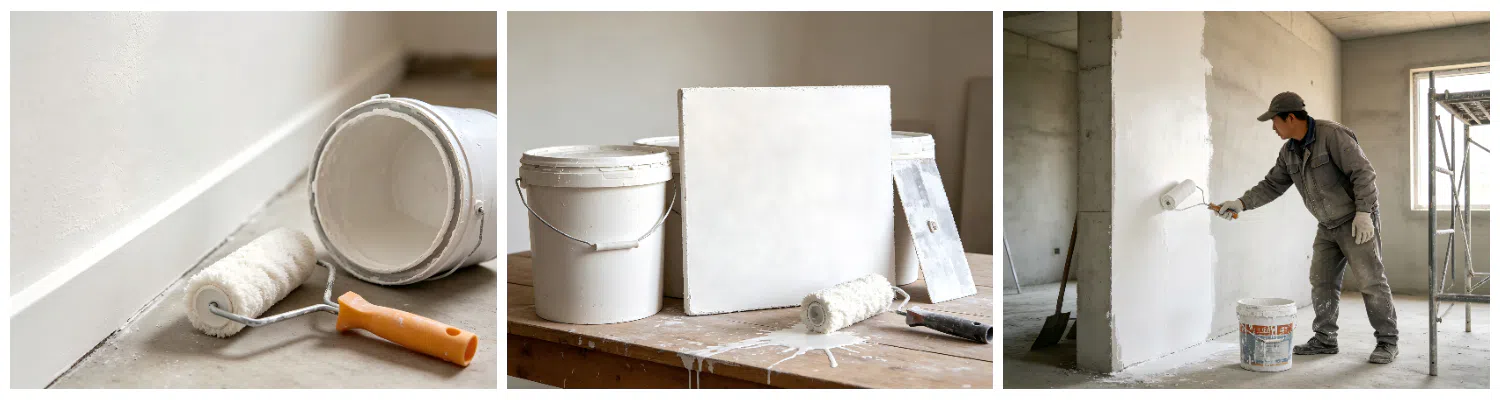
High Whiteness Titanium Dioxide CAS#13463-67-7: Picking a Grade
"White" isn't a spec. Buyers get burned by treating it like one.
When you compare offers for high whiteness titanium dioxide CAS#13463-67-7, look at the numbers that actually predict performance:
①TiO₂ content. Sulfate-process rutile runs 94% or so. Chloride grades hit 95–97%.
②Whiteness (L value) and tone. Higher L, better hiding.
③Oil absorption. Lower is friendlier to your resin budget.
④Particle size distribution. Tight and centered beats wide every time.
⑤Volatiles and sieve residue. Quality-of-life stuff for your production line.
Ask for a certificate of analysis with every lot. Good titanium dioxide powder suppliers send one before you ask. And hold batch consistency tight — a paint line tuned to one grade will throw defects when you swap sources cold.
Titanium Dioxide Inorganic Pigment for Plastic Masterbatch
Plastic masterbatch has its own rules. The pigment gets compounded into a carrier resin first, then dosed into the final polymer. So dispersibility is everything. Poor dispersion means specks, gels, and weak color strength on the film.
That's why titanium dioxide inorganic pigment for plastic masterbatch is usually sold with surface treatment — alumina or silica coatings, often with organic aids on top. Untreated grades disperse badly in polyolefins and can even catalyze degradation in outdoor plastics. Rutile wins here again: anatase breaks down polymer faster under UV, which is why white garden furniture fades when someone cuts corners with the wrong grade.
One buying note. If your product touches food packaging, remember the EU food ban applies to the package contents' formula, not the crate it ships in — but rules drift. Check current packaging guidance for your target market before committing a formulation.
The Market Right Now: September 2026 in Numbers
Here's where pricing stands, and it's actually an interesting month.
China's titanium dioxide market spent most of 2026 sliding. August alone saw a 9.1% drop to a stage low. Producers were selling titanium dioxide at or below cost. Operating rates sagged under 70%, and inventories piled up.
Then September hit — peak season — and the mood flipped.
On 11 September, LB Group, the industry's biggest name, issued a price increase letter: domestic titanium dioxide up 700 yuan per tonne, export up $100 per tonne. Shandong Jinhai and Shandong Dawn matched it the same day, each adding 700 yuan domestically and $100 on titanium dioxide exports. More than ten other producers followed within days — Anhui Ananda, Nanjing Titanium White, Guangxi Bluestar, Huiyun, and others. Industry watchers count this as the sixth collective price push this year.
The new numbers, roughly: LB's rutile grade moved from about 14,800 yuan to 15,500 yuan per tonne ex-works. Jinhai went from 14,600 to about 15,300. Dawn from 14,500 to 15,200. Sulfuric-acid-process rutile quotes now span 14,500 to 15,500 yuan, anatase sits at 13,000 to 13,500, and chloride-process material commands 15,300 to 17,000 yuan per tonne.
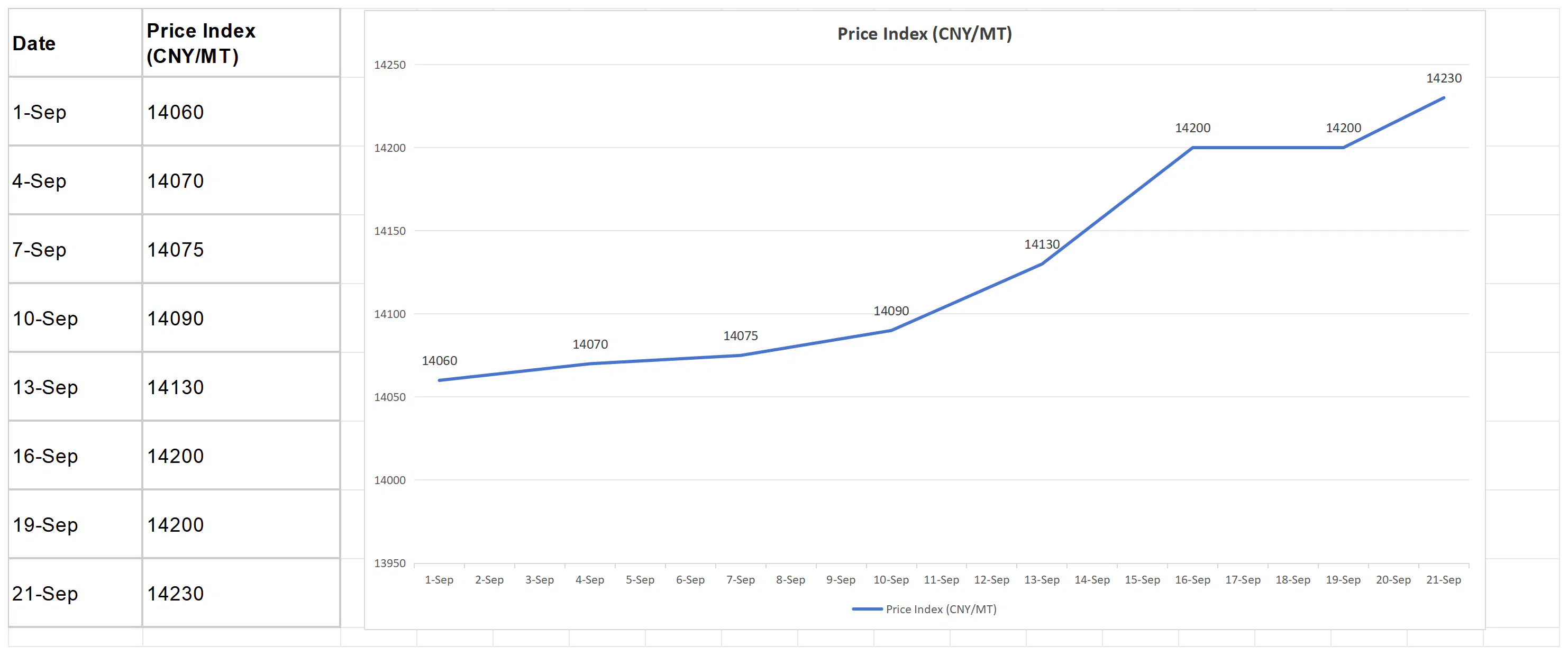
The SMM titanium dioxide index read 14,080 yuan on 14 September and 14,059 on the 16th. Flat day to day. That tells you something honest: the price letters went out, but actual transactions at the higher levels are still thin. Mainstream rutile transactions still cluster around 12,500 to 14,800 yuan, averaging near 13,650.
Why are producers pushing so hard when demand is merely okay? Cost. Titanium ore, sulfur, and sulfuric acid all stayed expensive through the slump. Margins went negative. As one analyst put it, prices had nowhere left to fall. Add seasonal restocking and thin spot inventory, and suppliers smelled a chance to repair margins.
What happens next is genuinely uncertain. Orders have stretched into early October at some plants, and export enquiries picked up. But inventory has largely shifted from factories to traders and downstream users, and it still needs digesting. Several analysts flag mid-to-late October as a risk window: if demand grows only slowly while plants run full, some producer will blink and cut first.
Translation for buyers. The floor looks solid for now. The ceiling is soft. Quotes may firm through early October, then wobble. If you need Q4 volume, contracting sooner beats later — but negotiate hard, because under the letters, real transaction prices still have room.
What This Means if You're Buying Now
Three moves make sense in late September 2026.
Nail down Q4 volume first. The price letters created a floor sentiment, and restocking season is live.
Qualify a second source. One producer's turnaround shouldn't stop your line, and with offers scattered between 12,500 and 15,500 yuan, the spread rewards shopping around.
Fix the price basis in writing. Domestic ex-works, FOB, or CFR — freight and duty swing hard enough this quarter to fake a price move.
Choosing a Titanium Dioxide CAS 13463-67-7 Supplier
Credentials to check before wiring anything:
A serious titanium dioxide CAS 13463-67-7 supplier shows you COAs, keeps grades consistent, and tells you honestly whether sulfate or chloride process fits your end use. A rutile titanium dioxide manufacturer factory with its own mine or long-term ilmenite contracts survives downcycles — that matters when the market wobbles again. For large volumes, bulk titanium dioxide dealers for coating industry customers can blend offers across plants; just get the actual plant of origin named in the contract. Rutile grade titanium dioxide wholesale trader quotes vary widely this month, so collect three before you sign. And for export, confirm which incoterm your titanium dioxide powder suppliers are quoting — the $100 export bump is real, but how it lands on your door varies.
Frequently Asked Questions
What is the chemical name for the compound with CAS number 13463-67-7?
Titanium dioxide, formally titanium(IV) oxide. Formula TiO₂. In pigment trade you'll mostly see it as rutile titanium dioxide or anatase titanium dioxide, named for the crystal structure.
Why was titanium dioxide banned?
In the EU, only as a food additive. The food safety authority concluded in 2021 that a genotoxic effect couldn't be excluded, so E171 lost its approval under Regulation (EU) 2022/63, effective from August 2022. Industrial uses — paint, plastics, inks — were never banned, and the separate "suspected carcinogen by inhalation" label was struck down by EU courts in 2022 and confirmed gone in August 2025.
What is the CAS number for titanium dioxide?
13463-67-7. One number covers both rutile and anatase pigment grades on safety data sheets.
Is titanium dioxide safe to use in toothpaste in the EU?
Tricky one. The food additive ban (E171) covers food, not cosmetics. Titanium dioxide remains an authorized colorant and UV filter in EU cosmetics, including toothpaste, under the cosmetics regulation. That said, the EU's consumer safety committee said in 2024 it couldn't fully exclude a genotoxic effect for some forms, so the debate isn't over. Non-EU markets still allow it broadly.
The Bottom Line
The EU restriction is a food story, not an industrial one. Your coatings, plastics, and inks stay legal — in Europe and everywhere else. The bigger story this month is the price floor China's producers just built. Quotes may not hold every gain the letters claim, but the downside looks capped.
Need a current quotation? Send your spec and target volume for rutile or chloride-process titanium dioxide CAS#13463-67-7, and we'll get you three comparable offers within 48 hours — full COAs included, export packing from 25-kilogram bags to jumbo sacks.


