
Product Description
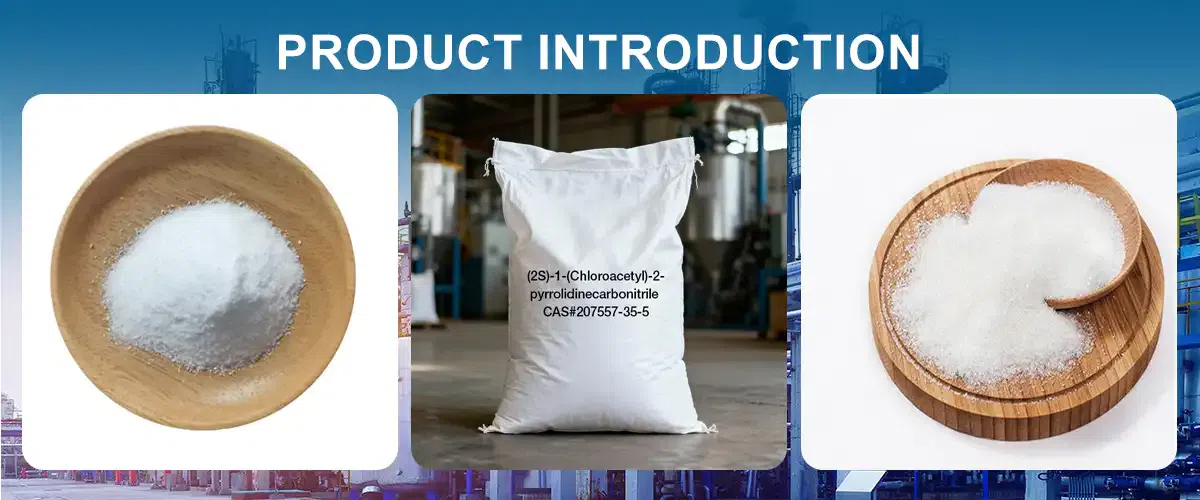
(2S)-1-(Chloroacetyl)-2-pyrrolidinecarbonitrile (CAS#207557-35-5) is an important chemical building block used in pharmaceutical synthesis. It appears as a white to light-yellow solid and is mainly utilized as a key raw material for the production of Vildagliptin, a prescription drug indicated for the treatment of Type 2 diabetes.
Properties
| Melting point | 52-53 °C |
| Boiling point | 363.1±37.0 °C(Predicted) |
| density | 1.27±0.1 g/cm3(Predicted) |
| storage temp. | under inert gas (nitrogen or Argon) at 2-8°C |
| solubility | Chloroform (Slightly), DMSO (Slightly), Methanol (Slightly) |
| form | Solid |
| pka | -4.65±0.40(Predicted) |
| color | Pale Yellow to Light Brown |
| Stability: | Hygroscopic |
| HS Code | 2933998090 |
Product Application
(2S)-1-(Chloroacetyl)-2-pyrrolidinecarbonitrile, also known as (2S)-N-chloroacetyl-2-cyanotetrahydropyrrole, is a key synthetic intermediate of Vildagliptin and is primarily used in the preparation of this pharmaceutical compound.
In the synthesis process, L-prolinamide is used as the starting material, with THF as the solvent and K₂CO₃ as an acid-binding agent to perform a chloroacetylation reaction, producing (S)-1-(2-chloroacetyl)-2-pyrrolidine carboxamide. The amide group is then converted into a nitrile group through a dehydration cyanation reaction using TFAA, resulting in the intermediate (2S)-N-chloroacetyl-2-cyanotetrahydropyrrole.
Subsequently, DCM is used as the solvent, K₂CO₃ serves as the acid-binding agent, and the intermediate undergoes a condensation reaction with 3-amino-1-adamantanol. After purification by column chromatography, Vildagliptin is obtained.
Factory Tour

Package And Shipping


