Product Description
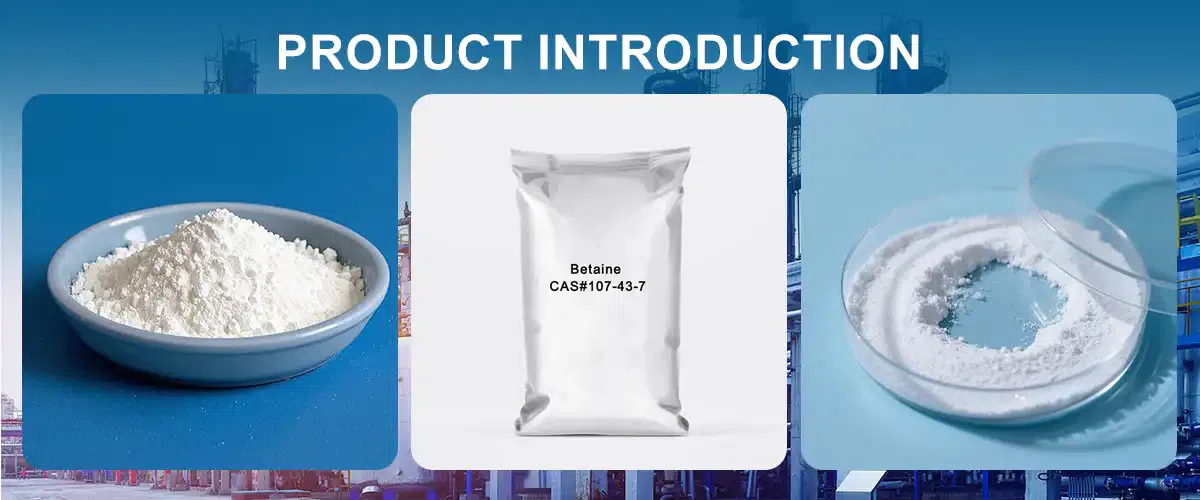
Betaine, also referred to as anhydrous betaine or trimethylglycine (TMG), serves as a critical methyl group donor. It participates in a wide range of biological processes, including liver function maintenance, cellular proliferation, and carnitine synthesis.
As an amino acid betaine and glycine derivative, it plays an essential role in modulating cellular hydration and sustaining normal physiological cell functions.
Properties
| Melting point | 310 °C (dec.) |
| Boiling point | 218.95°C (rough estimate) |
| density | 1.00 g/mL at 20 °C |
| vapor pressure | 0.05Pa at 25℃ |
| refractive index | 1.4206 (estimate) |
| FEMA | 4223 | BETAINE |
| storage temp. | 2-8°C |
| solubility | methanol: 0.1 g/mL, clear |
| form | Crystals or Crystalline Powder |
| pka | 1.83(at 0℃) |
| color | colorless |
| Odor | bland |
| biological source | sugar beets |
| Water Solubility | 160 g/100 mL |
| Sensitive | Hygroscopic |
| Merck | 141179 |
| BRN | 3537113 |
| Stability: | Stable. Hygroscopic. Incompatible with strong oxidizing agents. |
| InChIKey | KWIUHFFTVRNATP-UHFFFAOYSA-N |
| LogP | -3.1 at 20℃ |
| CAS DataBase Reference | 107-43-7(CAS DataBase Reference) |
| NIST Chemistry Reference | Methanaminium, 1-carboxy-n,n,n-trimethyl-, hydroxide, inner salt(107-43-7) |
| EPA Substance Registry System | Betaine (107-43-7) |
| Absorption | ≤0.05 at 280nm in methanol at 1M |
| ≤0.09 at 260nm in methanol at 1M | |
| Hazard Codes | Xn |
| Risk Statements | 20/21/22-36/37/38 |
| Safety Statements | 24/25-36-26 |
| WGK Germany | 3 |
| RTECS | DS5900000 |
| F | 46091 |
| TSCA | Yes |
| HS Code | 29239000 |
| Hazardous Substances Data | 107-43-7(Hazardous Substances Data) |
Product Application
Betaine is incorporated as an active ingredient in toothpaste for alleviating dry mouth symptoms. Furthermore, it is utilized for the management of homocystinuria, a metabolic disorder that disrupts the primary biosynthetic pathway of methionine.
Additionally, betaine aids the maintenance of immune function and improves athletic performance. It may also lower the risk of developing benign colorectal tumors known as colorectal adenomas.
Factory Tour

Package And Shipping